An automotive oscilloscope can reveal signal problems that a scan tool alone may miss, from intermittent sensor faults to noisy actuators and communication issues.
In this roundup, we focus on 10 strong options for technicians, advanced DIYers, and shop owners who want clearer diagnostics and better value.
Best 10 Automotive Oscilloscope Picks for 2026
Platform-Ready 4-Channel Scope
TOPDON Phoenix Scope 4-Channel Automotive Oscilloscope

- 4-channel scope with fast capture and replay
- 50M memory depth and zoomed waveform viewing
- Works only with compatible Phoenix tools
Best For: Phoenix tool users needing a dedicated automotive scope
Waveform Reference Book
Automotive Oscilloscopes: Waveform Analysis Guide
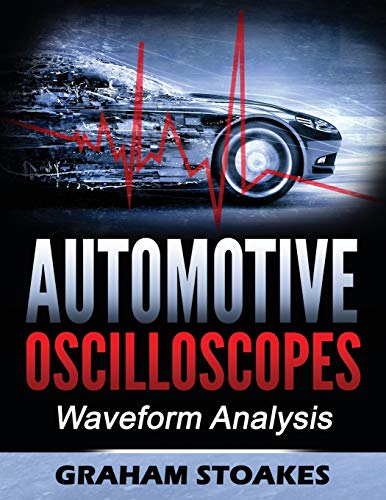
- Explains setup, use, and waveform interpretation
- Covers common automotive waveforms and tips
- Designed as a practical diagnostic reference
Best For: Learning automotive oscilloscope fundamentals and waveform analysis
Portable 3-in-1 Tester
FNIRSI 2C53T 2CH Automotive Oscilloscope

- Combines oscilloscope, multimeter, and signal generator
- 50 MHz bandwidth with 250 MSa/s sampling
- Battery-powered handheld design with Type-C charging
Best For: Portable automotive testing and all-in-one troubleshooting
Connected Professional Scope
Autel MaxiScope MP608 4-Channel Automotive Oscilloscope
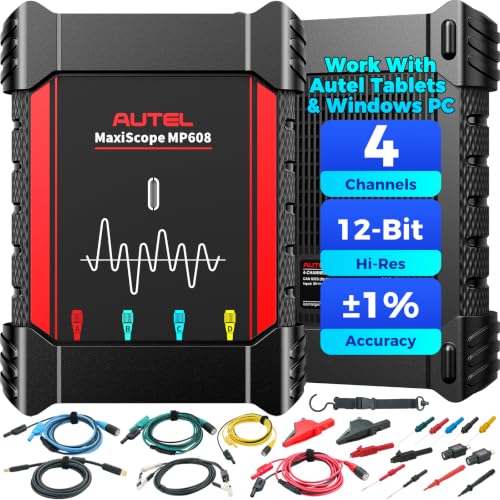
- 4-channel scope with ±1% accuracy and 12-bit resolution
- Works with Autel tablets and Windows 10/11 PCs
- AI-assisted math, probe, and case tools
Best For: Professional diagnostics with connected tablet or PC workflows
Portable Android Scope
Micsig SATO1004 4-Channel 100MHz

- 4-channel, 100MHz handheld scope
- Android OS with physical controls
- 32GB storage and remote app support
Best For: Portable diagnostic work with broad automotive test coverage
Touchscreen Value Scope

- 2-channel, 100MHz touchscreen oscilloscope
- Stores 1000 screenshots and 1000 waveform sets
- Built-in protection rated up to 400V continuous
Best For: Portable signal testing and basic automotive diagnostics
PC Diagnostic Multi-Channel

- 8 analog channels with 12-bit resolution
- 80+ automotive diagnostic functions included
- Programmable signal generator for crank and cam signals
Best For: Windows-based diagnostics that need many channels and signal simulation
Shop-Ready Diagnostic Multi-Tool
AUTOOL DM302 Multimeter Oscilloscope
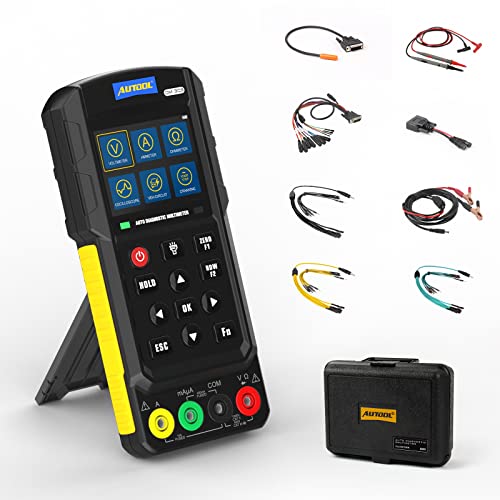
- True RMS multimeter with auto-ranging
- 500 kHz scope for automotive signal testing
- Includes leads for K-line, CAN bus, injectors, relays
Best For: Portable car diagnostics with multimeter and waveform testing
PC-Based 8-Channel Diagnostic Pick
Hantek 1008C USB Automotive Oscilloscope
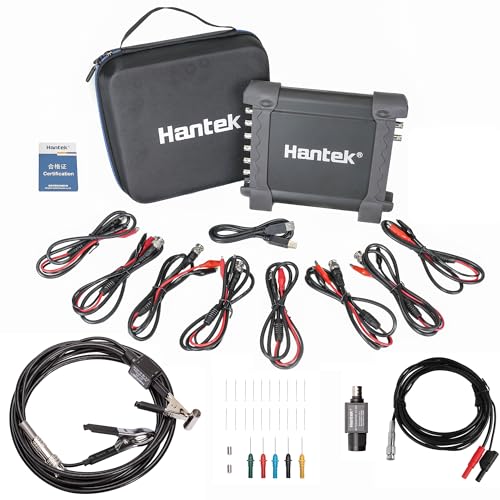
- 8-channel USB oscilloscope for Windows PCs
- 80+ automotive diagnostic functions included
- Programmable signal generator for crank/cam simulation
Best For: Windows-based vehicle diagnostics with multiple channels
Portable 3-in-1 Handheld Pick
ZT-703S Handheld Automotive Oscilloscope

- Dual-channel scope with up to 50 MHz bandwidth
- 25,000-count multimeter plus signal generator
- USB-C charging and data transfer for convenience
Best For: Portable mixed diagnostics with scope, meter, and generator
Platform-Ready 4-Channel Scope – TOPDON Phoenix Scope 4-Channel Automotive Oscilloscope
If you need an automotive oscilloscope for faster circuit, sensor, actuator, ignition, and communication testing, the TOPDON Phoenix Scope is built around technician workflow. It captures signals quickly, slows waveform display for easier review, and supports waveform recording and replay for follow-up analysis.
Best For: Technicians already using compatible Phoenix diagnostic tools who want a dedicated 4-channel scope for deeper analysis.
Pros:
- 4-channel design with fast capture and replay for signal review
- 50M memory depth plus zoom tools for global and detailed waveform views
- Advanced math functions and FFT support for more in-depth diagnostics
- 23 automatic measurements shown on one screen for quicker setup
Cons:
- Works exclusively with supported Phoenix Max/Smart/Elite/Lite/Plus tools
- Not compatible with Phoenix Nano or XLink
- Requires the right ecosystem, so it is not a standalone scope
Overall, this is a strong choice if you already work inside the Phoenix platform and want scope features that emphasize speed, storage, and analysis depth. It is less flexible than standalone units, but the integration and measurement workflow are clearly aimed at professional automotive diagnosis.
Waveform Reference Book – Automotive Oscilloscopes: Waveform Analysis Guide
This automotive oscilloscope book is focused on helping you understand waveform analysis and practical diagnostic use. It explains how scopes reveal the electrical behavior of vehicle systems, and it aims to make setup and interpretation less intimidating for real-world diagnosis.
Best For: Technicians, students, and DIY diagnosticians who want a straightforward reference on automotive waveforms and scope use.
Pros:
- Explains electrical principles, setup, and waveform interpretation
- Covers common automotive waveforms with diagnostic tips
- Written in a straightforward style meant to reduce setup confusion
- Useful as a reference for building systematic diagnostic routines
Cons:
- It is a printed guide, not a diagnostic tool
- Does not provide live equipment or software features
- Best value depends on whether you want training rather than hardware
As a learning resource, this title is best suited to users who want to become more comfortable with scope-based diagnosis before or alongside buying equipment. It is less about features and more about building practical understanding of automotive waveforms.
Portable 3-in-1 Tester – FNIRSI 2C53T 2CH Automotive Oscilloscope
The FNIRSI 2C53T is a compact automotive oscilloscope option for users who want an all-in-one handheld tool. It combines a 2-channel scope, a 19999-count multimeter, and a DDS signal generator, making it handy for mobile electrical testing and basic waveform comparison.
Best For: Portable diagnostics, hobby work, and users who want oscilloscope, meter, and signal generator functions in one device.
Pros:
- 3-in-1 design with oscilloscope, multimeter, and signal generator
- 50 MHz bandwidth and 250 MSa/s sampling for a handheld unit
- One-click saving and waveform export for PC comparison
- Built-in battery and Type-C charging support portable use
Cons:
- 1 Kpts record depth is modest compared with larger bench scopes
- Two channels may limit more advanced multi-signal testing
- Smaller 2.8-inch display may be less convenient for extended analysis
This model makes sense if portability and versatility matter more than deep bench-scope analysis. For automotive electronics repair, it offers useful measurement features in a compact package, especially when you want a multimeter and scope together.
Connected Professional Scope – Autel MaxiScope MP608 4-Channel Automotive Oscilloscope
The Autel MaxiScope MP608 is a 4-channel automotive oscilloscope built for professional diagnostics, with high-accuracy measurements and workflow tools that help organize test results. It supports oscilloscope, spectrum, and XY modes, plus simultaneous multi-view display for faster analysis.
Best For: Professional technicians who want a tablet- and PC-compatible scope with advanced analysis and workflow features.
Pros:
- 4-channel design with ±1% measurement accuracy and 12-bit vertical resolution
- Trigger actions help capture intermittent faults more effectively
- AI-generated math formulas, probe parameters, and built-in case library
- Supports tablet, Windows PC, and advanced analysis workflows
Cons:
- Requires compatible Autel scanners or Windows 10/11 PC
- More advanced than a basic handheld scope, so it may be overkill for casual users
- Depends on a connected device rather than working as a simple standalone unit
For shops that want a modern diagnostic workflow, the MP608 stands out for its accuracy, software support, and organized test management. It is best suited to users who will take advantage of the connected tablet and PC features rather than just basic waveform viewing.
Portable Android Scope – Micsig SATO1004 4-Channel 100MHz
If you want an automotive oscilloscope that feels more like a modern diagnostic tablet than a bench unit, the Micsig SATO1004 is built for that workflow. It pairs a 4-channel, 100MHz design with an Android-based interface, physical controls, and automotive-focused software for ignition, sensors, networks, charging, starter, and pressure testing.
Best For: Technicians who want a portable, touchscreen automotive oscilloscope with wireless and network-friendly workflow options.
Pros:
- 4 channels with 100MHz bandwidth and 1GSa/s sampling rate
- Android operating system with added physical button control panel
- Supports ignition, CAN, LIN, FlexRay, K, and pressure tests
- 32GB internal storage for waveforms, screenshots, and recorded videos
Cons:
- Premium feature set may be more than casual users need
- Remote operation depends on a stable network or Wi-Fi connection
The SATO1004 is a strong pick if you value speed, storage, and broad automotive test coverage in a handheld form factor. Its mix of touch control, physical buttons, and multiple I/O ports makes it geared toward efficient diagnostic work.
Touchscreen Value Scope – FNIRSI 1013D Plus 100MHz
The FNIRSI 1013D Plus is a practical automotive oscilloscope option if you want a compact touchscreen unit with core measurement tools. It offers 100MHz x2 bandwidth, 1GSa/s sampling, gesture-based controls, and storage for screenshots and waveform data, making it useful for everyday signal checks and basic diagnostics.
Best For: Users who want a portable touchscreen oscilloscope for general signal testing and basic automotive diagnostics.
Pros:
- 100MHz x2 bandwidth with 1GSa/s sampling rate
- 7-inch touchscreen with gesture operation and complete trigger functions
- Built-in high-voltage protection module rated up to 400V continuous
- Stores up to 1000 screenshots and 1000 waveform sets
Cons:
- Only 2 channels, which limits multi-signal testing compared with 4- or 8-channel units
- Four-hour battery life may be limiting for longer sessions
For straightforward measurements and portable use, the 1013D Plus covers the essentials well. Its mix of touchscreen convenience, storage, and protection makes it a solid entry-level automotive oscilloscope choice.
PC Diagnostic Multi-Channel – Hantek 1008C 8CH USB Scope
Hantek 1008C PC USB 8CH Automotive Diagnostic Digital Oscilloscope | DAQ/Programmable Generator
Check Price On AmazonThe Hantek 1008C is aimed at users who want an automotive oscilloscope tied to a Windows PC for detailed diagnostic work. It combines 8 analog channels, more than 80 automotive functions, and a programmable signal generator, making it useful for troubleshooting ignition, sensors, buses, actuators, and starting or charging systems.
Best For: Windows-based technicians who want multi-channel automotive diagnostics with signal generation.
Pros:
- 8 analog channels with 12-bit resolution and 4K memory depth
- More than 80 automotive diagnostic functions included
- Programmable signal generator can simulate crankshaft and camshaft signals
- USB 2.0 connection with PC software support for Windows
Cons:
- Requires a Windows PC and is not a standalone handheld unit
- Lower 2.4MSa/s real-time sampling rate than some portable scopes
If your workflow is centered on a laptop and you need many channels, the 1008C offers a lot of diagnostic flexibility. It stands out for its broad automotive function set and built-in signal generator in a compact USB format.
Shop-Ready Diagnostic Multi-Tool – AUTOOL DM302 Multimeter Oscilloscope
If you want an automotive oscilloscope that also behaves like a full-featured multimeter, this AUTOOL kit is built for broad troubleshooting. It covers voltage, current, resistance, frequency, continuity, duty cycle, ignition signal testing, and more, while the oscilloscope side adds waveform observation for common car circuits and sensors.
Best For: Technicians and DIYers who want one handheld tool for multimeter checks plus automotive waveform and signal testing.
Pros:
- Measures a wide range of electrical values, including AC/DC voltage, current, resistance, capacitance, frequency, duty cycle, and diode tests.
- Oscilloscope function supports automotive signals like ignition, camshaft, crankshaft, wheel speed, oxygen sensor, and motor drive signals.
- Includes True RMS and auto-ranging for easier, more accurate readings.
- Comes with multiple wiring leads for battery, injector, relay, K-line, CAN bus, ECU, and ignition pulse testing.
Cons:
- 500 kHz oscilloscope bandwidth is suited to automotive diagnostics, not lab-grade high-frequency work.
- At 3.7 pounds, it is heavier than a basic handheld meter.
- Best value comes from using the specialized automotive test leads, which add complexity.
Overall, this is a practical all-in-one choice if you want a portable automotive oscilloscope with strong multimeter coverage and dedicated car diagnostic functions. It is especially appealing when you need to test both general circuits and vehicle-specific signals from one device.
PC-Based 8-Channel Diagnostic Pick – Hantek 1008C USB Automotive Oscilloscope
This automotive oscilloscope is aimed at users who want a PC-connected diagnostic setup with lots of channels and built-in vehicle test modes. The Hantek 1008C combines 8-channel oscilloscope functions, more than 80 automotive diagnostic functions, and a programmable signal generator, making it useful for deeper system checks on vehicles and other electronics.
Best For: Windows users who want a USB automotive oscilloscope with multiple channels and broad diagnostic coverage.
Pros:
- Eight analog channels give it flexibility for multi-signal diagnostics.
- Includes more than 80 automotive diagnostic functions covering ignition, sensors, bus detection, actuator checks, and starting/charging.
- Programmable signal generator can simulate crankshaft and camshaft signals.
- 12-bit resolution and 4K memory depth support detailed signal viewing, with 20 automatic measurement modes.
Cons:
- Requires a PC and works with Windows software only.
- Not a handheld standalone unit, so it is less portable than battery-powered scopes.
- USB-based setup may be less convenient for quick roadside checks.
For users comfortable working from a laptop or desktop, this Hantek setup offers a strong mix of channel count, automotive test functions, and signal generation. It is a good fit when you want a bench-style diagnostic oscilloscope that can also handle vehicle-specific troubleshooting.
Portable 3-in-1 Handheld Pick – ZT-703S Handheld Automotive Oscilloscope
If you need a compact automotive oscilloscope that also includes a multimeter and signal generator, this 3-in-1 handheld unit is a versatile option. It offers dual-channel scope testing, 25,000-count multimeter mode, and waveform generation in a portable battery-powered design with Type-C charging and data transfer.
Best For: Users who want a handheld automotive oscilloscope for mixed electrical testing, waveform viewing, and signal generation.
Pros:
- Dual-channel oscilloscope supports pulse waves, circular waves, noise waveforms, and more.
- Switchable operating modes reach up to 50 MHz bandwidth in high-speed mode.
- Built-in 25,000-count multimeter adds resistance, capacitance, continuity, diode, and current measurements.
- Signal generator mode can output sine, square, and triangle waves.
Cons:
- Manual is important to review before use because of the product’s multiple functions.
- High-speed mode increases power consumption.
- Scope bandwidth is useful for many jobs, but it is still a handheld tool rather than a full bench oscilloscope.
As an all-in-one handheld, this model is attractive if you want mobility without giving up scope and multimeter functions. Its stronger bandwidth options make it a capable pick for users who expect to inspect a wider range of waveforms on the go.
How We Picked the Best Automotive Oscilloscope Options
We looked for models that balance diagnostic usefulness, channel count, portability, software support, and included accessories. The best Automotive Oscilloscope for you should make it easier to capture real-world waveforms, store data, and test modern vehicle systems without slowing you down.
We also favored tools with practical features such as multimeter integration, signal generation, rugged handheld designs, and compatibility with Windows PC or dedicated tablet platforms where that matters.
Quick Comparison: What Matters Most
Some buyers need a compact handheld unit for mobile work, while others need a PC-based system with more channels for deeper analysis. In general, 2-channel models suit basic sensor and ignition checks, 4-channel units offer better flexibility for timing and correlation tests, and 8-channel systems are best for advanced diagnostics and complex vehicle networks.
Also compare bandwidth, sample rate, display quality, probe quality, and software workflow. A simpler tool with reliable capture can outperform a more complex unit that is awkward to use in the bay.
Key Buying Factors for an Automotive Oscilloscope
Channel Count and Diagnostic Scope
Choose the number of channels based on the jobs you perform. Fewer channels are fine for straightforward troubleshooting, but more channels help when comparing crank, cam, injector, and CAN or K-line signals at the same time.
Portability and Power
If you work roadside, in a driveway, or under the hood often, a handheld Automotive Oscilloscope is usually the smarter pick. For bench work or long diagnostic sessions, PC-based models can provide a larger display and easier waveform review.
Software and Compatibility
Check whether the unit works with your preferred tablet, Windows PC, or proprietary app. Good software should make saving waveforms, zooming signals, and exporting reports simple.
Included Accessories and Test Leads
Accessories matter more than many buyers expect. Quality leads, clips, probes, and vehicle-specific adapters can save setup time and improve measurement confidence.
Who Should Buy Which Automotive Oscilloscope?
Technicians who need broad coverage should lean toward 4-channel or 8-channel systems. Mobile mechanics and DIY users who value simplicity may prefer a compact handheld Automotive Oscilloscope with multimeter functions. If you want a lower-cost way to learn waveforms, a basic dual-channel unit can be enough. If you diagnose modern electronics daily, prioritize a system with better software, stronger accessories, and enough channels to compare signals side by side.
Ultimately, the right choice depends on how often you diagnose, how complex the vehicles are, and whether you need speed, portability, or deeper data analysis most.