If you want to check a warning light before visiting a shop, the right scanner can save time, money, and guesswork. The best car diagnostic scanners make it easier to read fault codes, verify repairs, and understand what your vehicle is telling you.
In this roundup, we focused on easy-to-use tools that offer the best mix of accuracy, features, and value for everyday drivers and DIY mechanics.
Best 10 Car Diagnostic Scanners Picks for 2026
Budget Check-Engine Reader
ANCEL AD310 Classic OBD II Scanner

- Reads and clears emission-related codes
- Shows live data, freeze frame, and readiness
- Compact, no-battery design for easy use
Best For: Drivers who want a basic OBD2 scanner for check-engine light checks
All-System Starter Scanner
FOXWELL NT604 Elite OBD2 Scanner

- Scans engine, ABS, SRS, and transmission
- Includes live data, playback, and DTC library
- No download or extra software fee needed
Best For: Drivers who want affordable multi-system diagnostics
Best Simple Code Reader

- Reads/clears engine and emission codes
- Built-in DTC lookup with 42,000+ definitions
- No app, battery, or charger needed
Best For: Beginners who want a clear, easy engine code reader
Advanced Reset Scanner

- 16 reset functions for common maintenance tasks
- Scans engine, ABS, SRS, and transmission
- Live data graphs plus CAN FD/FCA AutoAuth
Best For: DIYers who want advanced diagnostics and reset functions
DIY Diagnostic Scan Tool

- Reads and clears engine fault codes fast
- Live data graphing for key sensor readings
- I/M readiness tools help with smog checks
Best For: DIY drivers who want a simple engine code reader with live data
Budget Code Reader
MOTOPOWER MP69033 OBD2 Scanner

- Reads and clears engine codes with DTC lookup
- Live data, freeze frame, and I/M readiness included
- Vehicle-powered design needs no charger
Best For: Drivers who want an affordable OBD2 reader for basic diagnostics
Feature-Rich Scan Tool

- Reads engine codes and supports some ABS coverage
- Battery tester adds alternator and charging checks
- Oil reset and free repair app support included
Best For: DIYers who want a more versatile scanner with maintenance features
DIY Code Reader
- Reads and clears engine fault codes
- Includes live data, freeze frame, and I/M readiness
- Built-in DTC lookup and broad OBDII compatibility
Best For: DIY owners who need a simple plug-and-play code reader
Pro Repair Scanner

- Reads Engine, ABS, SRS, and Transmission codes
- Includes 12+ reset and service functions
- AutoVIN, live data graphing, and free lifetime updates
Best For: Mechanics and advanced DIYers needing broad diagnostics and reset services
Full-System Value Scanner

- Full-system scans across engine, ABS, SRS, transmission, and HVAC
- 30 reset and relearn functions for common maintenance
- AutoVIN touchscreen scanner with graphing and wide coverage
Best For: Users who want a feature-rich scanner for diagnostics and maintenance resets
Budget Check-Engine Reader – ANCEL AD310 Classic OBD II Scanner
If you want a simple car diagnostic scanner for basic check-engine troubleshooting, the ANCEL AD310 focuses on the essentials. It reads and clears emission-related trouble codes, shows live data, freeze frame, and I/M readiness, and powers directly from your vehicle with no battery or charger needed.
Best For: Drivers who want a compact, easy-to-use code reader for basic OBD2 engine diagnosis and emissions checks.
Pros:
- Reads and clears engine-related codes quickly
- Supports live data, freeze frame, and I/M readiness
- Compact, lightweight, and powered by the OBD2 port
- Wide compatibility with many 1996+ OBD2 vehicles
Cons:
- Only supports emission-related diagnostics
- Does not work on OBDI vehicles
- No ABS, SRS, or transmission functions
The AD310 is a practical pick if you mainly need a fast way to confirm why the check engine light is on. It keeps things straightforward, which makes it a solid home or travel tool for basic code reading.
All-System Starter Scanner – FOXWELL NT604 Elite OBD2 Scanner
The FOXWELL NT604 Elite is a step up from a basic car diagnostic scanner if you want coverage beyond the engine light. It scans ABS, SRS, transmission, and engine systems, includes live data and a built-in DTC library, and works right out of the box with no extra software download required.
Best For: Car owners who want affordable multi-system diagnostics without paying dealership prices.
Pros:
- Scans engine, ABS, SRS, and transmission systems
- Includes live data, playback, print, and DTC lookup
- No extra software fee and no download needed to start
- Comes with a protective case for storage and transport
Cons:
- Does not support service functions like oil reset or relearn
- Cannot clear crash/collision data in SRS systems
- Vehicle compatibility can vary by make, model, and year
This scanner is a good fit if you want broader diagnostic coverage than a basic code reader but do not need advanced repair functions. It is designed as a reliable health monitor, not a repair tool.
Best Simple Code Reader – ANCEL AD410 OBD2 Scanner
The ANCEL AD410 is a straightforward car diagnostic scanner for checking engine and emissions issues without extra setup. It reads and clears codes, shows live data and freeze frame, and gives you built-in code definitions so you can understand the check engine light before heading to a shop.
Best For: Beginners and DIY drivers who want an easy engine code reader with clear on-screen guidance.
Pros:
- Built-in DTC lookup with 42,000+ code definitions
- Supports live data, freeze frame, I/M readiness, and O2/EVAP tests
- No app, battery, or charger required
- Color display and simple menu make it beginner-friendly
Cons:
- Engine and emission codes only
- No ABS, SRS, transmission, or service reset support
- Compatibility still depends on the vehicle
For basic OBD2 troubleshooting, the AD410 offers useful depth without becoming complicated. It is a sensible choice if you want more guidance than a bare-bones code reader but do not need advanced system coverage.
Advanced Reset Scanner – XTOOL D5S OBD2 Scanner
If you need more than basic car diagnostic scanners, the XTOOL D5S is built for deeper maintenance work. It covers engine, ABS, SRS, and transmission diagnostics, adds 16 reset functions, and supports live data in text or graph form for more detailed troubleshooting.
Best For: DIYers and home mechanics who want advanced diagnostics plus reset functions for common maintenance jobs.
Pros:
- Includes 16 reset functions such as EPB, SAS, BMS, TPMS, and throttle relearn
- Reads engine, ABS, SRS, and transmission systems
- Supports live data graphs and CAN FD/FCA AutoAuth compatibility
- Can read, clear, and help verify repairs on many modern vehicles
Cons:
- Compatibility should be checked before ordering
- Some vehicles may show integrated system behavior
- Feature access can vary by vehicle make, model, and year
The D5S stands out if you want a scanner that can handle both diagnostics and common service tasks. It is a stronger fit for someone who plans to do more than read trouble codes and clear the check engine light.
DIY Diagnostic Scan Tool – FOXWELL NT301 OBD2 Scanner
If you want a practical car diagnostic scanner for check engine light issues, the FOXWELL NT301 focuses on fast code reading, clearing, and live data without extra setup. It plugs in, powers from the vehicle, and gives you a straightforward way to confirm fault codes, check readiness, and review sensor data before heading to a shop.
Best For: DIY drivers who want a simple, plug-and-play engine code reader with live data and smog-check help.
Pros:
- Reads and clears engine fault codes quickly with one click.
- Includes live data graphing for sensors, fuel trims, coolant temperature, and RPM.
- Has I/M readiness hotkeys plus red-yellow-green status indicators for inspection prep.
- Supports EVAP and O2 sensor tests for deeper OBDII troubleshooting.
Cons:
- Focused on OBDII engine diagnostics, not non-OBDII systems like ABS or airbag.
- Compatibility varies by year, make, model, and VIN.
Overall, the NT301 is a solid choice if you want a dependable, no-fuss scanner for common engine issues and emissions checks. Its live graphing and readiness tools make it more useful than a basic code reader while still staying easy to use.
Budget Code Reader – MOTOPOWER MP69033 OBD2 Scanner
The MOTOPOWER MP69033 is a compact car diagnostic scanner built for basic engine-light troubleshooting and everyday OBDII checks. It reads and clears codes, shows freeze frame and live data, and pulls vehicle information without needing a battery or charger.
Best For: Drivers who want an affordable, straightforward OBD2 code reader for basic check-engine diagnostics.
Pros:
- Reads and clears check engine codes with built-in DTC lookup.
- Shows live data, real-time curve data, freeze frame, and I/M readiness.
- Supports 9 protocols and multiple languages, including English, Spanish, and French.
- Powered directly by the vehicle, so no separate battery or charger is needed.
Cons:
- Does not support ABS, airbag, or oil service light systems.
- Best suited for OBDII engine diagnostics rather than broader vehicle repair coverage.
For shoppers who mainly need a low-cost scanner to check engine codes and view live data, the MP69033 covers the basics well. Its compact size and simple power setup make it a practical glove-box tool for routine diagnostics.
Feature-Rich Scan Tool – Innova 5210 OBD2 Scanner
The INNOVA 5210 is a more feature-packed car diagnostic scanner for drivers who want engine-code reading plus extra maintenance checks. Along with OBD2 live data and emissions readiness, it adds battery testing and oil reset support, making it a useful all-around tool for common driveway diagnostics.
Best For: DIYers and home mechanics who want more than a basic code reader, including battery and oil reset functions.
Pros:
- Reads and clears engine codes, with ABS coverage available on some vehicles.
- Includes battery testing to help check alternator health and reduce surprise breakdowns.
- Offers live data, drive cycle readiness, and oil reset support.
- Works with the free RepairSolutions2 app for verified fixes, parts ideas, and cost estimates.
Cons:
- Feature coverage may vary by vehicle, so compatibility checking is important.
- ABS support is not universal across all makes, models, and years.
The 5210 stands out if you want a scanner that can handle both fault-code diagnosis and a few useful maintenance tasks. It is a strong pick for users who like app-based repair guidance and want more confidence before paying for shop work.
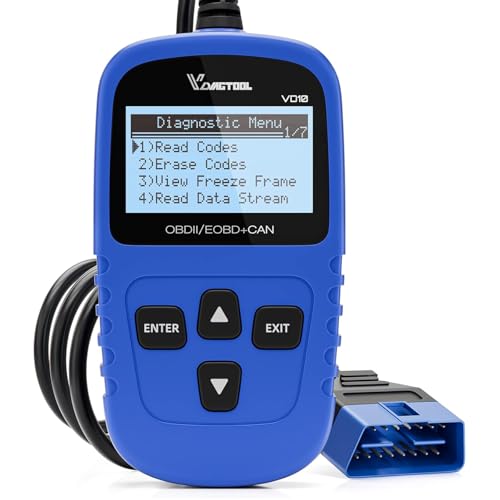
DIY Code Reader – VDIAGTOOL VD10 OBD2 Scanner
If you want straightforward car diagnostic scanners for basic check-engine troubleshooting, the VDIAGTOOL VD10 keeps things simple. It plugs into the OBD2 port, reads and clears codes, shows live data and freeze frame info, and includes built-in DTC definitions so you can get to the cause faster without searching online.
Best For: DIY drivers who want an easy plug-and-play scanner for engine codes, readiness checks, and basic live data.
Pros:
- Reads and clears codes, including pending and manufacturer-specific DTCs
- Shows live data, freeze frame, I/M readiness, and vehicle information
- Built-in database with more than 3000 code definitions
- Compatible with most OBDII-compliant vehicles and all major OBDII protocols
Cons:
- Focused on engine/OBD2 functions rather than advanced all-system diagnostics
- Best suited to 12V OBDII vehicles, not older non-OBD2 cars
The VD10 is a practical pick if you mainly need a dependable scanner for routine fault-code checks and smog-readiness prep. It offers the core features most home users need without adding complexity.
Pro Repair Scanner – BLCKTEC 460T OBD2 Scanner
Among car diagnostic scanners, the BLCKTEC 460T stands out for shoppers who want more than a basic code reader. It covers engine, transmission, ABS, and SRS faults, adds all-system diagnostics, and includes a long list of reset and service functions for maintenance and repair work at home or in a small shop.
Best For: Home mechanics and pros who want advanced diagnostics, service resets, and broad vehicle coverage.
Pros:
- Reads and clears Engine, Transmission, ABS, and SRS codes
- Includes 12+ reset services such as oil, TPMS, EPB, BMS, SAS, DPF, and throttle reset
- Offers live data, freeze frame, graphing, recording, replay, and overlay for analysis
- Features AutoVIN, AutoScan, AutoReLink, free lifetime updates, and RepairSolutions2 access
Cons:
- Feature availability depends on the specific year, make, and model
- Some users may need to verify compatibility before buying
The 460T is a strong choice if you want a scanner that can handle more serious diagnosis and maintenance tasks. Its reset functions and advanced data tools make it especially useful for vehicles that need more than standard OBD2 troubleshooting.
Full-System Value Scanner – XTOOL D6S OBD2 Scanner
If you’re comparing car diagnostic scanners for deeper repair work, the XTOOL D6S is built to go well beyond basic code reading. It supports full-system scans, 30 maintenance functions, and coverage for engine, ABS, SRS, transmission, HVAC, and other modules, giving DIYers and technicians a more complete picture of vehicle issues.
Best For: Drivers, DIYers, and mechanics who want full-system diagnostics and a wide set of maintenance resets.
Pros:
- OE full-system scanning with support for engine, ABS, SRS, transmission, HVAC, and more
- 30 maintenance and relearn functions, including oil reset, EPB, SAS, TPMS, ABS bleed, and injector coding
- AutoVIN, touchscreen operation, and up to 4 graphing streams for easier analysis
- Supports CAN FD and FCA AutoAuth, with wide model coverage and multilingual support
Cons:
- Available functions vary by vehicle, so compatibility should be checked first
- Some FCA AutoAuth requirements are not included with the device
The D6S is a versatile option if you want a scanner that can handle both diagnostics and common maintenance procedures. Its full-system depth and broad reset menu make it a practical upgrade over basic OBD2 readers.
How We Picked the Best Car Diagnostic Scanners
We prioritized broad vehicle compatibility, clear fault-code reading, reliable live-data support, and a feature set that matches real-world use. For this list of Car Diagnostic Scanners, that meant separating simple engine-code readers from more advanced tools that can access ABS, SRS, transmission, and service-reset functions.
We also looked for models that are practical for home garages: intuitive menus, readable displays, strong update support where applicable, and a price-to-feature balance that makes sense for first-time buyers and experienced DIYers alike.
Quick Comparison
If you only need to confirm and clear a check engine light, a basic OBD2 code reader is usually enough. If you want deeper diagnostics, look for scanners with live data, freeze-frame information, and access to multiple vehicle systems. Advanced units can also handle maintenance resets such as oil service, EPB, SAS, and battery registration, which may be worth it if you do your own upkeep.
Key Buying Factors for Car Diagnostic Scanners
Compatibility
Make sure the scanner works with your vehicle year, make, and model. Most OBD2 tools support 1996-and-newer gas vehicles in the U.S., but system coverage and reset features vary widely.
System Coverage
Basic readers focus on engine codes. More capable Car Diagnostic Scanners can also read ABS, SRS, transmission, and other modules, giving you a fuller picture of what is going on.
Live Data and Freeze Frame
Live data helps you watch sensor readings in real time, while freeze-frame data shows the conditions present when the fault was triggered. Both are useful for confirming whether a problem is intermittent or persistent.
Reset Functions
If you maintain your own vehicle, resets for oil life, EPB, throttle body, battery, or steering angle can be a major convenience. Just remember that reset features are only useful if they match your vehicle’s needs.
Ease of Use
Simple menus, a clear screen, and a durable cable or Bluetooth connection can make a big difference. The best tool is the one you will actually use when a warning light appears.
Who Should Buy Which Car Diagnostic Scanners?
Budget-minded drivers who mainly want to read and clear engine codes should stick with a straightforward code reader. DIY owners who want more confidence diagnosing warning lights may prefer a scanner with live data and multiple-system access. Enthusiasts and frequent home mechanics should consider advanced Car Diagnostic Scanners with reset services, broader module coverage, and stronger long-term value.
If you are unsure where to start, choose the simplest tool that covers your current needs, then step up only if you expect to use advanced features regularly.