Small workshops need effective dust control without sacrificing valuable floor space. The best dust extractors for small workshops balance suction, filtration, capacity, portability, and compatibility with the tools you use most.
This roundup compares compact HEPA extractors, portable dust collectors, and larger bagged systems to help you choose a practical setup for sanding, routing, sawing, and general cleanup.
Best 10 Dust Extractors for Small Workshops Picks for 2026
Best HEPA Filtration

- Automatic filter cleaning every 15 seconds
- HEPA filtration and up to 150 CFM
- Power-tool activation with adjustable suction
Best For: Tool-based dust extraction with strong filtration
Best High-Volume Collector

- 1 HP motor with 800 CFM capacity
- Portable four-wheel base
- 2.5-micron standard bag filtration
Best For: Stationary woodworking tools and larger dust loads
Best Jobsite Mobility
- 150 CFM from a 15-amp motor
- Automatic filter cleaning every 30 seconds
- Power-tool actuation and 15-foot hose
Best For: Mobile tool work in workshops and on jobsites
Best Tabletop Design
- Compact 23-by-8-inch benchtop footprint
- Up to 725 CFM with variable speed
- Adjustable hood and two grounded outlets
Best For: Small bench projects and targeted dust collection
Compact HEPA Pick

- HEPA filtration with high-power suction
- Automatic tool start and touch controls
- Compact 15-liter mobile design
Best For: Portable workshop cleanup and small tool-use tasks
Best for Everyday Use

- 1,300 CFM airflow from a 14-amp motor
- 50-gallon dust collection bag
- Dual 4-inch tool inlets and mobile base
Best For: Woodworking shops with stationary machines and heavier dust loads
Connected Mobile Extractor

- HEPA filter with automatic tool start
- Bluetooth remote start and stop
- Manual cleaning and tool-free filter changes
Best For: Mobile woodworking and compact workshop setups
Compact Workshop Collector
- 660 CFM airflow with a 4-inch dust port
- 12-gallon, 5-micron collection bag
- Mobile base plus optional wall mount
Best For: Compact woodworking shops needing flexible dust collection
Quiet Wet/Dry Extractor
- 151 CFM with 98 inches of water lift
- Tool-activated autostart outlet
- 66 dB operation with long cord and hose
Best For: Indoor workshops needing quiet, wet/dry tool cleanup
Handheld Blower Extractor

- Blower and dust-collection modes
- 177 MPH concentrated airflow
- Six-speed control and portable design
Best For: Targeted garage, workshop, and jobsite cleanup
Best HEPA Filtration – Bosch VAC090AH
For small workshops that need dependable dust extractors for small workshops, the Bosch VAC090AH combines automatic filter cleaning, strong airflow, and HEPA filtration in a 9-gallon wet/dry canister. Its power-tool activation and adjustable suction make it practical for grinder and other tool-based applications.
Best For: Small workshops using power tools where HEPA filtration and sustained suction are priorities.
Pros:
- Automatic filter cleaning cycles every 15 seconds to help maintain suction.
- HEPA filter captures 99.97% of particles at 0.3 microns or larger.
- Delivers up to 150 CFM with up to 97 inches of static water lift.
- Power-tool activation and a Power Broker suction dial improve application control.
Cons:
- The corded design limits placement away from outlets.
- Its 9-gallon canister is larger than a compact tabletop collector.
The VAC090AH is a strong choice when filtration, automatic cleaning, and tool integration matter more than the smallest footprint. Its 28-pound body and wheels still make it reasonably mobile around a workshop.
Best High-Volume Collector – SHOP FOX W1727
The SHOP FOX W1727 is a traditional 1 HP dust collector for small workshops that need high-volume air movement. With an 800 CFM suction capacity, a portable four-wheel base, and a 2.5-micron standard bag filter, it suits stationary woodworking setups.
Best For: Small woodworking shops collecting dust from stationary tools and larger work areas.
Pros:
- Provides an 800 CFM air-suction capacity.
- 1 HP motor supports workshop dust-collection duties.
- Portable base includes four wheels for easier repositioning.
- Motor is compatible with 120V or 240V single-phase power and is prewired for 110V.
Cons:
- The 55-pound body and tall 54.5-inch profile take up substantial space.
- The standard bag filtration is listed at 2.5 microns rather than HEPA-level filtration.
Choose the W1727 when airflow capacity and a wheeled collector are more important than compact storage or fine-particle filtration. Its larger footprint makes it better suited to a dedicated corner of the workshop.
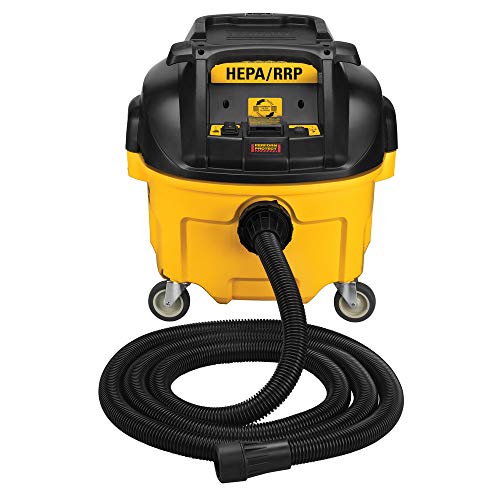
Best Jobsite Mobility – DEWALT DWV010
The DEWALT DWV010 is a practical option among dust extractors for small workshops when portability and power-tool control are important. Its 8-gallon canister, 15-amp motor, HEPA filter, automatic filter cleaning, and 15-foot antistatic hose support mobile tool work.
Best For: Small workshops and jobsites that need a mobile extractor with power-tool actuation.
Pros:
- Automatic filter cleaning pulses every 30 seconds for continuous operation.
- 15-amp motor delivers 150 CFM of airflow.
- Power-tool actuation controls the extractor’s on/off operation.
- Heavy-duty wheels, casters, and a 15-foot antistatic hose support mobility.
Cons:
- Its listed 80 dB noise level may be noticeable in a small enclosed workshop.
- The 1.25-inch hose diameter may limit compatibility with some larger dust ports.
- HEPA compliance for the stated EPA RRP rule requires DWV9330 filters.
The DWV010 balances useful airflow with a relatively compact 22-pound body. It is especially appealing for users who move between tools and want automatic filter cleaning without stopping frequently.
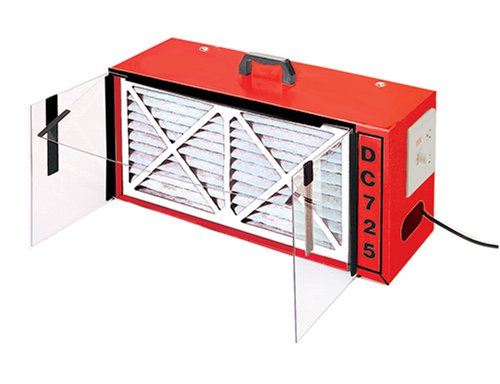
Best Tabletop Design – PSI Woodworking DC725
The PSI Woodworking DC725 is a specialized tabletop collector for small workshops focused on carving, sanding, grinding, woodburning, and small woodturning projects. Its compact 23-by-8-inch footprint, variable speed, adjustable hood, and three quiet fans make it easy to position near a bench.
Best For: Benchtop carving, sanding, grinding, woodburning, and small woodturning work.
Pros:
- Compact tabletop footprint and a carrying handle support easy placement.
- Three maintenance-free computer-grade fans provide up to 725 CFM.
- Variable-speed control helps adjust airflow for different tasks.
- Includes two grounded 115V outlets and a filter.
Cons:
- Its tabletop design is not intended as a large-capacity central dust collector.
- The supplied filter is listed as a 2-by-10-by-20-inch filter, so replacement availability may matter.
- It is designed primarily for small bench projects rather than broad shop cleanup.
The DC725 stands out when space is limited and dust-producing work happens directly at a bench. Its adjustable hood and variable speed offer more targeted control than a general-purpose floor collector.
Compact HEPA Pick – Festool CT 15
For small workshops that need portable dust extractors for small workshops, the Festool CT 15 combines HEPA filtration, automatic tool start, and high-power suction in a compact canister design. Its 15-liter container and integrated accessory storage make it practical for mixed cleanup and tool-use tasks.
Best For: Small workshops needing a compact, portable extractor for floors, furniture, upholstery, and general workshop cleanup.
Pros:
- HEPA filter and adjustable high-performance turbine support fine-dust capture.
- Automatic tool start and touch controls simplify operation.
- Compact, stable chassis with steel axles is easy to move and designed for durability.
- Includes a crevice nozzle, upholstery brush, and 15-liter container.
Cons:
- Its 15-liter capacity is considerably smaller than a dedicated 50-gallon collector.
- It has one power level.
The CT 15 is a strong fit when portability, HEPA filtration, and convenient accessory storage matter more than maximum collection volume. It is especially suited to smaller jobs and mobile cleanup.
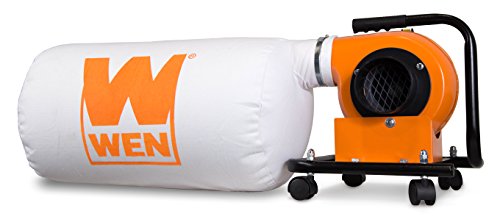
Best for Everyday Use – WEN DC1300
The WEN DC1300 takes a traditional approach to dust extractors for small workshops, using a 14-amp motor and 50-gallon collection bag to handle larger amounts of woodworking dust. Its 1,300 CFM airflow and mobile base make it a practical choice for stationary shop tools.
Best For: Small woodworking workshops that need high airflow, large collection capacity, and mobility between machines.
Pros:
- Moves up to 1,300 cubic feet of air per minute.
- Large 50-gallon vertical collection bag reduces emptying frequency.
- Dual 4-inch inlets allow connection to up to two tools at once.
- Four swivel casters provide a mobile base for workshop repositioning.
Cons:
- The listed filtration is 5-micron rather than HEPA.
- Its larger collector format may be less convenient for tight spaces than a compact canister.
- It has one speed and one power level.
Choose the DC1300 when collection volume and airflow are the priorities. It is better suited to a machine-focused woodworking setup than to portable, fine-detail cleanup around the whole shop.
Connected Mobile Extractor – Festool CT MIDI I
For compact dust extractors for small workshops, the Festool CT MIDI I adds HEPA filtration, automatic tool start, and Bluetooth remote control to a portable canister format. Manual filter cleaning and tool-free filter changes help maintain convenient day-to-day operation.
Best For: Small workshops and mobile woodworking tasks where remote control, compact handling, and convenient filter maintenance are valuable.
Pros:
- HEPA filtration supports fine-dust collection.
- Integrated Bluetooth allows remote start and stop.
- Manual filter cleaning helps maintain suction performance.
- Compact chassis, four wheels, internal hose garage, and tool-free filter changes improve usability.
Cons:
- The supplied notes do not specify a collection capacity.
- It has one power level.
- Its compact design is intended for mobility rather than very high-volume collection.
The CT MIDI I is a convenient premium option for users who move between tasks and appreciate Bluetooth control and straightforward maintenance. Consider it when portability and workflow features matter more than a large dust bag.
Compact Workshop Collector – WEN DC3401
For small workshops needing dedicated dust extractors for small workshops, the WEN DC3401 offers a compact rolling design, a 4-inch dust port, and airflow rated up to 660 CFM. Its onboard handle, lockable casters, and optional wall mount make it practical where storage and mobility matter.
Best For: Woodworkers who want a compact collector for compatible tools and flexible floor or wall-mounted storage.
Pros:
- 660 CFM airflow from a 5.7-amp motor and 6-inch impeller
- 12-gallon, 5-micron zippered collection bag
- Lockable swivel casters and optional wall mount improve placement flexibility
- Compact 17-pound design with an onboard carrying handle
Cons:
- Its single-speed operation offers less airflow control
- The brushed motor may be less refined than higher-end extractor designs
- The 4-inch port may require adapters for some tools
The DC3401 is a straightforward choice for small-shop dust collection, especially when a mobile base and compact footprint are more important than advanced controls.
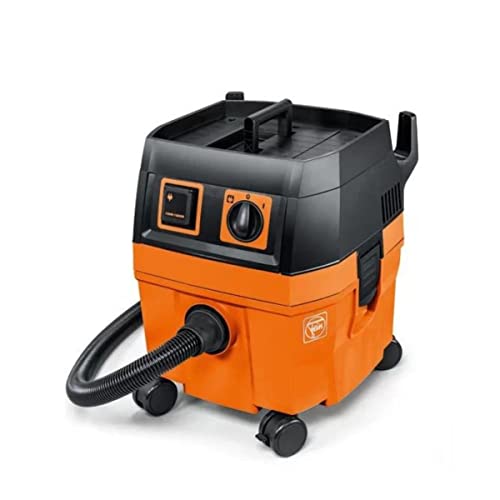
Quiet Wet/Dry Extractor – Fein Turbo I
The Fein Turbo I is a versatile option among dust extractors for small workshops, combining wet/dry cleanup with tool-activated suction. Its 151 CFM turbine, 98-inch water lift, long cord, and low 66 dB operating noise suit indoor workshop and jobsite use.
Best For: Workshop users who need quieter wet/dry extraction and automatic activation with compatible power tools.
Pros:
- 1100W turbine delivers 151 CFM and 98 inches of water lift
- Autostart outlet includes a power-on delay for tool synchronization
- 19.7-foot cord and 13-foot hose provide useful working reach
- Large swivel wheels support movement in tight spaces
Cons:
- Its 5.8-gallon capacity is smaller than the WEN collector’s 12-gallon bag
- At 25 pounds, it is less lightweight for frequent carrying
- The included warranty is one year
Choose the Fein when quieter operation, wet/dry capability, and automatic tool control justify a more feature-focused extractor for indoor work.
Handheld Blower Extractor – 2-in-1 Jobsite Cleaner
This handheld 2-in-1 unit takes a different approach to dust extractors for small workshops by combining blower and collection functions. Its concentrated 177 MPH airflow, flexible hose, dust bag, and six-speed control make it useful for targeted cleanup in garages, workshops, and jobsites.
Best For: Users who want a portable tool for blowing debris from tight areas and collecting light workshop or jobsite dust.
Pros:
- Switches between blower and dust-collection modes
- 177 MPH concentrated airflow reaches cracks, corners, and rails
- Six-speed variable control supports more precise airflow adjustment
- Compact handheld form is easy to maneuver in tight spaces
Cons:
- It is a handheld blower vacuum rather than a wheeled shop extractor
- The supplied notes do not specify dust-bag capacity or CFM
- Its collection setup may be less suitable for continuous high-volume extraction
The XC051 is best viewed as a flexible spot-cleaning companion, particularly for corners, concrete debris, wood chips, and tasks where portability matters more than large-capacity collection.
How We Picked the Best Dust Extractors for Small Workshops
We compared these 10 models by looking at the features that matter most in a limited workspace: filtration, airflow or suction, collection capacity, portability, noise-conscious design, tool compatibility, and ease of maintenance. The selection includes both fine-dust extractors designed for power tools and higher-airflow collectors intended for stationary woodworking equipment.
HEPA-rated options are especially useful for capturing fine particles from sanding, concrete work, and other applications where airborne dust is a concern. Larger bagged collectors can be more practical for shavings and chips from table saws, planers, and jointers, but they may not replace a true fine-dust extractor.
Quick Comparison
| Best For | Look For | Recommended Type |
|---|---|---|
| Portable power tools | High suction, tool activation, compact design | HEPA dust extractor |
| Fine sanding dust | HEPA filtration and automatic filter cleaning | Dedicated extractor |
| Table saws and planers | High CFM, larger bags, mobile base | Workshop dust collector |
| Small benches or limited storage | Small footprint and flexible mounting | Portable or tabletop collector |
| Wet and dry cleanup | Wet/dry capability and durable tank | Wet/dry extractor |
Key Buying Factors for Dust Extractors for Small Workshops
Filtration and Dust Type
For fine dust, prioritize HEPA filtration or the highest-quality filter system available. Coarser wood chips require airflow and adequate collection, while sanding dust benefits more from strong sealed suction and fine filtration.
Airflow Versus Suction
CFM is important for moving chips through hoses and ducts, but suction pressure matters when connecting to sanders, routers, and other handheld tools. Match the extractor to the tool rather than choosing by motor amperage alone.
Capacity and Maintenance
A larger bag or tank means fewer interruptions, but it also takes more room. Automatic filter cleaning helps maintain performance during demanding work, while accessible bags and filters make routine servicing easier.
Portability and Connections
Look for locking casters, a stable mobile base, hose storage, and tool-start functionality if you move between workstations. Check hose diameter and adapter availability before buying, especially for sanders and benchtop machines.
Who Should Buy Which Dust Extractors for Small Workshops?
Choose a compact HEPA extractor if your workshop centers on handheld sanders, circular saws, routers, or concrete tools. Choose a larger dust collector if you primarily operate stationary woodworking machines that produce chips and require high airflow. A tabletop or wall-mountable design suits very small spaces, while a wet/dry model is the better all-purpose choice for mixed cleanup tasks.
Before ordering, confirm the extractor’s filtration rating, electrical requirements, hose connection, collection method, and available replacement bags or filters. The right match will control dust more consistently and keep your workshop easier to clean without overwhelming the space.