Garage air quality can change quickly when you cut, sand, finish, or run power tools. The best air filtration systems help capture airborne dust while letting you adjust fan speed without interrupting your work.
We compared 10 garage-ready options by airflow, controls, filtration features, mounting design, coverage claims, and practical workshop usability.
Best 10 Garage Air Purifiers with Remote Controls Picks for 2026
Workshop Dust Specialist

- 300/350/400 CFM airflow settings
- 5-micron and 1-micron filtration
- RF remote with timer and ceiling hardware
Best For: Woodworking garages and workshops
Large-Garage Coverage Pick

- Rated for up to 3,500 square feet
- Dual-sided intake and 500 m³/h CADR
- PM2.5 sensor and remote control
Best For: Large garages and multipurpose spaces
High-CFM Workshop Option

- 1,050-1,350 CFM airflow
- MERV-11 filters with built-in ionizer
- Ceiling, workbench, or direct-mount installation
Best For: Larger woodworking garages
Pet-Odor Convenience Pick

- Rated for spaces up to 1,500 square feet
- HEPA plus activated carbon filtration
- Remote, auto mode, PM2.5 monitor, and timer
Best For: Multipurpose garages with pet or household odors
Workshop-Focused Pick
ECOMAX MCF03 Ceiling Air Filtration System

- 300/350/400 CFM three-speed airflow
- Washable dual-filter design
- Remote control and timer up to 26 feet
Best For: Woodworking shops and dusty garages
Large-Space Choice
PAKEOI ZX001 HEPA Air Purifier

- Dual-sided intake for large spaces
- Washable pre-filters and PM2.5 display
- 15 dB or less Sleep Mode
Best For: Large garages and open-concept spaces
Remote-Control Classic
WEN 3410 Air Filtration System
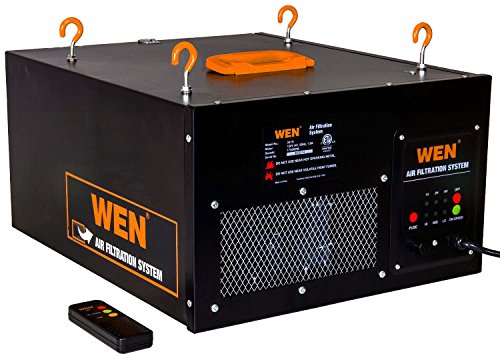
- 300/350/400 CFM three-speed airflow
- RF remote works through obstructions
- One-micron filter and five-micron pre-filter
Best For: Workshops up to 400 square feet
Best Ceiling-Mounted Pick
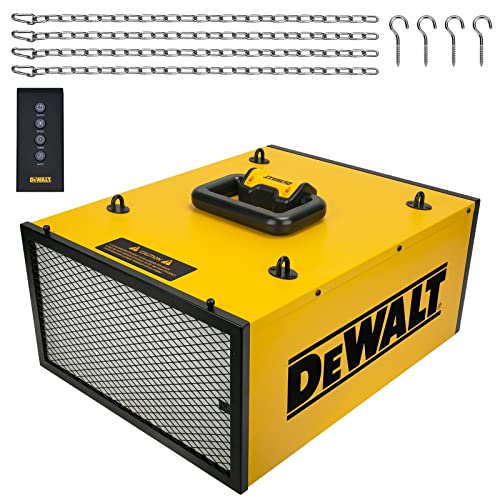
- H11 HEPA and washable pre-filter
- Remote, four modes, and timer settings
- Ceiling-mount design saves floor space
Best For: Woodworking garages needing overhead dust filtration
Best Ionizer Option

- 580/780 CFM two-speed airflow
- Remote and touch controls
- Built-in ionizer with 270° intake
Best For: Workshops seeking airflow and ionizer features
Best High-Capacity Choice

- Up to 1100 CFM and 1,100 sq. ft. coverage
- RF remote works up to 26 feet
- Three speeds and 1–12-hour timer
Best For: Large garages and woodworking shops
Workshop Dust Specialist – POWERTEC AF4001E
For garage air purifiers with remote controls, the POWERTEC AF4001E is built specifically for woodworking and workshop dust. Its hanging design, three airflow settings, and RF remote make it practical for managing airborne particulates without interrupting your project.
Best For: Woodworking garages and workshops that need ceiling-mounted dust filtration with long-range wireless control.
Pros:
- Three airflow settings provide 300, 350, or 400 CFM.
- Includes 5-micron outer and 1-micron inner filters.
- RF remote supports power, speed, and 1-, 2-, or 4-hour timer settings.
- Lightweight design includes hooks and mounting hardware for ceiling installation.
Cons:
- Its 400 CFM maximum is more suited to a focused workshop than a very large garage.
- Designed primarily for airborne workshop dust rather than general household air-cleaning needs.
The POWERTEC is a straightforward choice when your garage doubles as a woodworking space. The two-stage filtration and remote timer are useful for clearing lingering dust after work, while the ceiling-mount format preserves floor and bench space.
Large-Garage Coverage Pick – AMEIFU F1 H13 HEPA
If you want garage air purifiers with remote controls that also provide broad-room coverage, the AMEIFU F1 offers a large stated coverage area, dual-sided intake, and H13 HEPA filtration. Its sensor-driven auto mode can adjust operation as air quality changes.
Best For: Large garages or multipurpose spaces where wide coverage, air-quality monitoring, and remote operation are priorities.
Pros:
- Rated for spaces up to 3,500 square feet with a 500 m³/h CADR.
- Dual-sided intake is designed to increase purification speed.
- H13 HEPA filtration is listed at 99.97% efficiency for 0.1- to 0.3-micron particulates.
- Remote control operates settings, timers, filter-life checks, and child lock.
Cons:
- Its 15 dB sleep mode and bedroom-oriented features may be more than a basic workshop requires.
- The supplied notes do not specify a garage-specific mounting system.
- Filter replacement costs and intervals are not provided.
The F1 stands out for whole-space air cleaning rather than heavy sawdust collection. The PM2.5 display, infrared sensor, and remote control make it convenient for monitoring and adjusting air quality from across a large garage.
High-CFM Workshop Option – Abestorm DecDust 1350IG
Among garage air purifiers with remote controls, the Abestorm DecDust 1350IG is aimed at demanding workshop environments. It combines 1,050-1,350 CFM airflow, a MERV-11 filter system, built-in ionizer, and flexible placement options for garages where dust and sawdust are ongoing concerns.
Best For: Larger woodworking garages needing high airflow, multiple installation choices, and remote or touch operation.
Pros:
- High airflow range of 1,050-1,350 CFM and stated coverage up to 1,700 square feet.
- Can hang from the ceiling, sit on a workbench, or screw directly to the ceiling.
- Remote works from up to 27 feet away, with touch controls also available.
- Includes four replaceable MERV-11 filters and mounting hardware.
Cons:
- Rated noise is relatively high at 60-69 dBA.
- Filters are described as needing replacement every 2-4 months.
- It cannot be shipped to California because it does not meet that state’s air-cleaner regulation requirements.
The DecDust 1350IG offers substantially more airflow than compact workshop units, making it a strong fit for active woodworking areas. Its higher noise rating and maintenance schedule are worth weighing against the performance and installation flexibility.
Pet-Odor Convenience Pick – Large-Room HEPA Purifier
For garages that also serve as pet areas, hobby rooms, or general storage spaces, this unit is one of the more home-oriented garage air purifiers with remote controls. It pairs HEPA and activated carbon filtration with odor reduction, a PM2.5 monitor, and aromatherapy features.
Best For: Smaller or moderate-size garages where pet odors, household dust, smoke, and remote convenience matter more than workshop-grade airflow.
Pros:
- Designed for spaces up to 1,500 square feet.
- HEPA and activated carbon filtration target particles and odors.
- Remote control, three fan speeds, auto mode, and 2-, 4-, or 8-hour timers add convenience.
- Includes PM2.5 monitoring, child lock, filter reminder, and fragrance compartment.
Cons:
- The notes do not provide a CADR or airflow figure for direct comparison with workshop units.
- Its home-pet focus may be less suitable for heavy sawdust or active woodworking.
- Aromatherapy may not be desirable in every garage environment.
This purifier is a practical choice for a cleaner-feeling multipurpose garage, especially where odors are a bigger issue than concentrated sawdust. The remote and automatic sensing simplify routine operation, but workshop users should look for a unit with explicitly higher airflow if dust generation is substantial.
Workshop-Focused Pick – ECOMAX MCF03 Ceiling Air Filtration System
For shoppers comparing garage air purifiers with remote controls, the ECOMAX MCF03 is a practical choice for workshops where airborne woodworking dust is the main concern. Its ceiling-mount design, washable dual filters, three airflow settings, and timer support help keep air circulating without taking up floor space.
Best For: Woodworking shops, garages, and hobby workspaces that need overhead dust filtration.
Pros:
- Three speeds provide 300, 350, or 400 CFM of airflow.
- Outer and inner washable filters target larger and smaller dust particles.
- Remote and manual controls work from up to 26 feet away.
- One-, two-, and four-hour timer settings support automatic shutoff.
Cons:
- Its ceiling-mounted form is designed more for workshops than typical living spaces.
- Noise is rated from 58 to 62 dB, so it is not the quietest option.
The MCF03 stands out when garage air filtration needs are tied to sanding, carving, grinding, or sawing. The included hanging hardware adds installation flexibility, while the two-year service guarantee provides extra support.
Large-Space Choice – PAKEOI ZX001 HEPA Air Purifier
The PAKEOI ZX001 is a versatile option for shoppers seeking garage air purifiers with remote controls that can also serve large rooms or open spaces. Its dual-sided intake, washable pre-filters, PM2.5 monitoring, and automatic fan adjustment are designed for continuous everyday air cleaning.
Best For: Large garages, open areas, offices, and homes dealing with dust, pet hair, or odors.
Pros:
- Dual air intakes are designed to provide stronger airflow than single-inlet models.
- Washable pre-filters help capture larger debris and reduce maintenance waste.
- PM2.5 display and Auto Mode provide real-time air-quality feedback and fan adjustment.
- Sleep Mode operates at 15 dB or less and includes four fan speeds.
Cons:
- The HEPA filter is recommended for replacement every six to eight months.
- The supplied notes do not specify the remote-control operating range.
- Users must remove the protective plastic bag from the filter before operation.
Choose the ZX001 if you want garage air purification with broader room versatility and visible air-quality feedback. Its washable pre-filters and ozone-free certification claims support convenient routine use, while the aromatherapy pad is an optional extra.
Remote-Control Classic – WEN 3410 Air Filtration System
The WEN 3410 is a straightforward contender among garage air purifiers with remote controls, especially for workshops up to 400 square feet. It combines three airflow levels with replaceable filters, a programmable timer, and an RF remote that can work even when the unit is not in direct line of sight.
Best For: Small to medium workshops and garages up to 400 square feet that prioritize convenient remote operation.
Pros:
- Three airflow settings deliver 300, 350, or 400 CFM.
- RF remote works from up to 26 feet and does not require direct visibility.
- Programmable timer can automatically shut the unit off.
- Includes a one-micron filter and five-micron pre-filter.
Cons:
- Both filters are replaceable rather than washable.
- Its stated coverage is limited to rooms up to 400 square feet.
- Noise is rated from 50 to 60 dB.
The WEN 3410 makes sense for buyers who want simple controls and dependable RF remote access in a contained workspace. Its replaceable filtration and compact housing are practical, but ongoing filter costs should be included in the ownership budget.
Best Ceiling-Mounted Pick – DEWALT DWXAF101
The DEWALT DWXAF101 is a practical choice among garage air purifiers with remote controls, especially for workshops where overhead mounting helps preserve floor space. Its two-stage filtration, four operating modes, timer settings, and included remote make it easy to manage airborne dust while woodworking.
Best For: Woodworking garages and shops that need ceiling-mounted filtration with automatic operation.
Pros:
- Two-stage filtration uses a washable cotton pre-filter and H11 HEPA filter rated to capture over 95% of 0.3-micron particles.
- Remote control, four modes, and 1-, 2-, 4-, and 8-hour timer settings simplify operation.
- Ceiling hooks and chains save floor space, while the filter indicator helps with maintenance.
Cons:
- At 64 dB, it may be noticeable in quieter work areas.
- Its listed filtration capability focuses on dust rather than a broad range of contaminants.
Choose this model if overhead installation and HEPA-style fine-particle filtration are priorities. The three-year warranty and washable pre-filter add useful ownership value for regular shop use.
Best Ionizer Option – Abestorm DecDust 780IG
The Abestorm DecDust 780IG is one of the more feature-focused garage air purifiers with remote controls, combining a 580/780 CFM fan range with a built-in ionizer. Remote and touch controls, a wide 270-degree air intake, and a compact profile suit active garages and workshops.
Best For: Garage workshops wanting remote-controlled dust filtration with an integrated ionizer.
Pros:
- Remote control and touch controls provide flexible operation.
- Two-speed 580/780 CFM airflow supports circulation in a workshop or garage.
- Built-in ionizer and 270-degree air intake add to its air-treatment features.
Cons:
- The supplied specifications list a HEPA-like filter and 11-micron particle retention, so it is less clearly suited to very fine particles than a true HEPA model.
- No timer setting is listed in the supplied details.
This is a sensible option when airflow, compact installation, and ionizer functionality matter more than documented fine-particle performance. Review the filtration specifications carefully if your main concern is very small woodworking dust.
Best High-Capacity Choice – Purisystems PuriCare 1100
The Purisystems PuriCare 1100 is a high-capacity option among garage air purifiers with remote controls, with airflow rated up to 1100 CFM and coverage listed for up to 1,100 square feet. Its three speeds, RF remote, reusable two-stage filters, and extended timer make it well suited to larger workshop spaces.
Best For: Larger garages and woodworking shops that need strong airflow and long timer settings.
Pros:
- Three speed settings and up to 1100 CFM create circular airflow for larger spaces.
- RF remote works from up to 26 feet and does not require direct line of sight.
- 1- to 12-hour timer and tool-free, reusable two-stage filters support convenient maintenance.
Cons:
- At 40.9 pounds and more than 24 inches wide, it may require substantial mounting or placement space.
- The listed 66 dB noise level may be noticeable during quieter tasks.
- The product notes say it cannot be shipped to California because it does not meet California air-cleaner requirements.
Consider the PuriCare 1100 when coverage and remote range are more important than a compact footprint. Its two-stage mechanical filtration is designed for airborne workshop dust, but it should complement—not replace—a source dust-collection system.
How We Picked the Best Garage Air Purifiers with Remote Controls
We focused on systems suited to garages, workshops, and woodworking spaces rather than relying only on residential room-purifier claims. Our comparison considered airflow capacity, fan-speed settings, remote-control convenience, intake and exhaust design, filter access, mounting options, and the type of dust each unit is designed to handle.
Remote operation is especially useful when a purifier is ceiling-mounted or positioned across the garage. We also noted features such as built-in ionizers, air-quality displays, washable pre-filters, and multiple intake sides. These features can improve convenience, but they do not replace source collection at the tool or proper ventilation.
Quick Comparison
| What to Compare | Best For | Why It Matters |
|---|---|---|
| 300–400 CFM | Small garages and hobby workshops | Suitable for lighter dust loads and smaller spaces |
| 700–1,100 CFM | Busy workshops or larger garages | Moves more air and can shorten cleanup cycles |
| 1,300+ CFM | High-dust woodworking areas | Useful when substantial airborne dust is produced |
| RF remote | Ceiling-mounted installations | Improves control without walking to the unit |
| Ionizer or air-quality display | Users wanting extra monitoring or treatment | Adds functionality, but should not replace filtration |
Key Buying Factors for Garage Air Purifiers with Remote Controls
Airflow and Garage Size
Choose airflow based on the room volume, dust production, and how often the space is used. A compact 300- or 400-CFM unit may suit a hobby area, while a larger garage or active woodworking shop may benefit from 780 CFM or more. Manufacturer coverage figures are useful for comparison, but real performance depends on ceiling height, layout, filter condition, and open doors.
Filtration and Dust Control
Check the replacement-filter design and whether filters are washable, disposable, or staged with a pre-filter. An overhead air cleaner helps capture suspended particles, but it is not a substitute for a dust collector connected directly to saws, sanders, and routers.
Mounting, Noise, and Controls
Confirm that the mounting hardware and ceiling structure can support the unit. Compare speed settings, timer functions, RF range, and operating noise. A remote is most valuable when it works reliably through typical garage obstructions and allows you to run the cleaner after finishing a project.
Ionizers and Air-Quality Displays
Ionizers may appeal to buyers seeking an additional particle-control feature, while PM displays can help monitor changing conditions. If you are sensitive to ozone, verify the manufacturer’s emissions information before choosing an ionizer-equipped model.
Who Should Buy Which Garage Air Purifiers with Remote Controls?
Choose a 300–400-CFM system for occasional hobby work, compact garages, and buyers who want straightforward remote control. Move to a midrange 780–1,100-CFM model for frequent woodworking, larger spaces, or heavier airborne dust. A higher-capacity system is the better fit for demanding shops, provided the garage has suitable mounting support and adequate filter availability.
For the best overall setup, pair the purifier with tool-connected dust collection, a shop vacuum, regular filter maintenance, and ventilation when appropriate. That combination offers more effective control than relying on any standalone air cleaner.